Monday, April 30, 2007

back to melamine (or, why you need organic- and biochemistry)

the melamine contamination of pet food and the subsequent discovery of contamination of hogs is all over the news (and in class!). but, what is melamine and why is it important?

as reported in today's NYTimes:
For years, producers of animal feed all over China have secretly supplemented their feed with the substance, called melamine, a cheap additive that looks like protein in tests, even though it does not provide any nutritional benefits, according to melamine scrap traders and agricultural workers ...
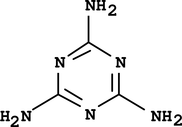
well, here is melamine (from Acta Cryst., 2005, E61:o222-o224), some of it's uses include manufacturing heat-resistant handles for pots (and toasters!), cutlery, dishes and flooring.


note the many nitrogen residues, most importantly the primary amines (-NH2). It both mimics the peptide bond (C-N) and has three primary amines; both of which may react with the reagents in the most common protein assays (look here). You can see, that even directly measuring nitrogen (by near-infrared spectroscopy) would result in an inflated estimate of crude protein!

a friend reminded me of the 'olden' days, when unethical feedstuff purveyors would use urea to increase the apparent protein content of their product.

so; what is lethal about melamine? it's hard to say. toxicological reports are equivocal. it is also a distinct possibility that the melamine added to the feed was, itself, contaminated. perhaps by formaldehyde, or other compounds used in its synthesis. in addition, since much of the melamine came from scrap traders, perhaps there was contamination in the recovery/grinding process.

Powered by ScribeFire.

Tuesday, April 17, 2007

just do it

there are many of us working in or with the poultry industry from Va Tech. given the horrific tragedy, some students have come up with a GREAT idea, as a show of support for their fellow students and the university community.

this weekend will be the Penn State Blue&White weekend, a celebration of spring (and spring football) at Penn State. some students have started a facebook group calling for everyone to wear the maroon and orange. other schools are joining in.
even Wilkes University.

this weekend; everybody is a hokie.

[crossposted http://gfb1.blogspot.com and http://gfb1.wordpress.com]

Monday, April 16, 2007

Big day for food (and fuel)


Two news stories from The Wall Street Journal highlight the economic relationships between food and fuel. (btw -- WSJ has some public access articles, but many/most require registration and $$$)

Notably, Tyson (NYSE: TSN) and Conoco (NYSE: COP) have announced a partnership to make biodiesel from animal fat.


Tyson prouduces about 300 million gallons of beef, pork and chicken fat each year. About 58% of its fat production will go to the diesel deal once it is ramped up. ... Producing one 42-gallon barrel of renewable diesel requires about one barrel of animal fat. Each barrel requires, on average, two steers, or 16 hogs or 1,300 chickens, Tyson officials say. (2007.04.16 WSJ)


Continuing in this vein, WSJ also reports (in a subscriber-only article, The Outlook, Section A, p. 2, 2007.04.16 or ProQuest) that fuel prices (as well as corn prices and bad weather) have contributed to make food a “bigger potential contributor to inflation than it has been at least since 2004.” The USDA reports that food prices are likely to climb by 2.5 to 3.5% in the coming year. Wells Fargo & Co analysts suggest that the increase could reach 4.5%.

In this regard, Tyson, Kellog, Heinz and Kraft have all increased prices to retail and food-services customers.

Technorati Tags:

Wednesday, April 4, 2007

More corn


Certainly, corn prices have been volatile over the last week. It appears that while we won't be going back to $2.50/bushel corn, we probably won't be hitting $4.50/bushel in the near future.

Nevertheless, Pilgrims Pride is continuing their commitment to a 5% cutback in chicken production during the upcoming year. This should help to put overall chicken production back in line with demand -- and, perhaps, helping to increase wholesale prices.


But, here is a tidbit about Pilgrims Pride that I did NOT know:


Regardless of the soybean decline, analysts considered the plantings report a big positive for chicken producers, particularly Pilgrim's Pride Corp., which doesn't hedge for grain -- making it more susceptible to market fluctuations in price.


How do you hedge? Or, more importantly, why is it important?

Friday, March 30, 2007

Corn, wonderful corn


As we all have been tracking corn prices, we know that corn typically trades between $2 and $3 a bushel. Over the last several weeks, prices have been hovering around $4. A bushel of corn for May delivery was trading at $3.74 a bushel today (Friday) on the Chicago Board of Trade.


It looks as if farmers are responding to the increased price (in part, due to ethanol production) with an increased planting. Let's hope the weather holds!


0331-Biz-Webcorn


(graphic from the NYTimes)

Tuesday, March 27, 2007

Avian flu in the news


A new article in the NYTimes highlights the probability (NOT possibility) that the avian flu will mutate and infect humans.


Nature reports that:


The first human case of infection with the H5N1 avian influenza virus has been reported by the Ministry of Health in Laos. The cumulative number of human H5N1 infections worldwide on 1 March 2007 was 277, with 167 deaths.


further, their study guide on the 1918 pandemic is sobering indeed.


Technorati Tags:

Wednesday, March 14, 2007

Birds and Dinosaurs


It's spring break in Happy Valley, and it's a great time to catch up on some reading.


One of my favorite books (which I use in both Avian Biology and the PA Governors School for Agricultural Sciences) is Pat Shipman's Taking Wing. This wonderfully readable book details the discovery, evaluation and interpretation of the Archaeopteryx fossils.
... so ... it was a real treat to finally get my copy of Luis Chiappe's Glorified Dinosaurs: The Origin and Early Evolution of Birds. A wonderfully illustrated and the color photos are fantastic; I can't wait to use it in class. If you like birds (or dinosaurs), this book is definitely for you.


It was also a wonderful coincidence to simultaneously see Chris Organ's new paper in Nature, Origin of avian genome size and structure in non-avian dinosaurs. More technical, perhaps, but with some interesting insights!


and... who says professors do nothing during spring break!?!?


Technorati Tags: